































What's New in HaloITSM - 2026 Second Release
Discover all the key new features and improvements that have been released in version 2.236.



Start your free 30-day Halo trial with all features and modules included.
No credit card required - simply choose the setup that best fits your business and get started in minutes.

Tenant

Teams & Agents

Users


Tickets
Halo AI

Asset Mgmt

Billing

Calendars & Appts

Call Mgmt

Chat

Contracts

Document Mgmt
Forecasting
Event Mgmt

Knowledge Base

Items & Stock

Notifications

Project Mgmt

Purchase Orders

Reporting

Self-Service Portal

Services

SLAs

Software Releases

Suppliers

Supplier Contracts

Time Management

Language

Custom Objects

Integrations

Migrations
Organisation
Teams & Agents
Users
Tickets
Halo AI
Asset Mgmt

Billing
Calendars & Appts
Call Mgmt
Chat

Agreements
PDF Templates
Documents

Forecasting
Event Mgmt
Knowledge Base
Items & Stock
Notifications
Project Mgmt
Purchase Orders
Quotations
Remote Support
Reporting

Sales
Sales Orders
Self-Service Portal
Service Catalogue
SLAs
Suppliers

Supplier Agreements
Time Management
Language
Custom Objects
Integrations
Migrations
Organisation
Teams & Agents
Contacts
Quotations
Sales
Records
Halo AI

Segments

Campaign
Calendars & Appts
Call Mgmt
Chat
Forecasting
Knowledge Base
Items & Stock
Notifications
Project Mgmt
Reporting
Self-Service Portal
SLAs
Language
Custom Objects
Integrations
Migrations
Organisation
Teams
Agents

Roles

Contacts
Call Mgmt
SMS
Social Media
Chat
Self-Service Portal

Web Widget
Forms

Workflows

Rules

Canned Text

Surveys
Knowledge Base
Notifications
SLAs
Suppliers
Halo AI
Areas

Views
Calendars & Appts
Reporting
Time Mgmt
Language
Custom Objects
Integrations
Migrations
Forecasting
Project Mgmt
Discover all the key new features and improvements that have been released in version 2.236.
The second 2026 release brings a broad set of improvements across access control, approvals, automation, reporting, and the Self-Service Portal. This release focuses on giving administrators more control, improving day-to-day efficiency for agents, and making it easier to tailor HaloITSM to the way your organisation works.
New integrations with AssetBots, and SailPoint IdentityNow extend HaloITSM’s reach across your technology ecosystem. Let’s take a closer look at what’s new.
This release brings a significant expansion to HaloITSM’s AI capabilities, covering new ways to automate and gain insight using AI across the platform.
Introducing AI Ability, a custom set of instructions sent to an AI to generate a response can now be used directly within integration runbooks. To add an AI Ability to a runbook, set a step’s Action Type to ‘AI Ability’. Input variables can be referenced in the instructions, and the AI’s response can be used to populate output variables so AI generated response can be leveraged across the platform. A checkbox is also available to force the AI’s output to be JSON, allowing multiple runbook variables to be populated from a single response.
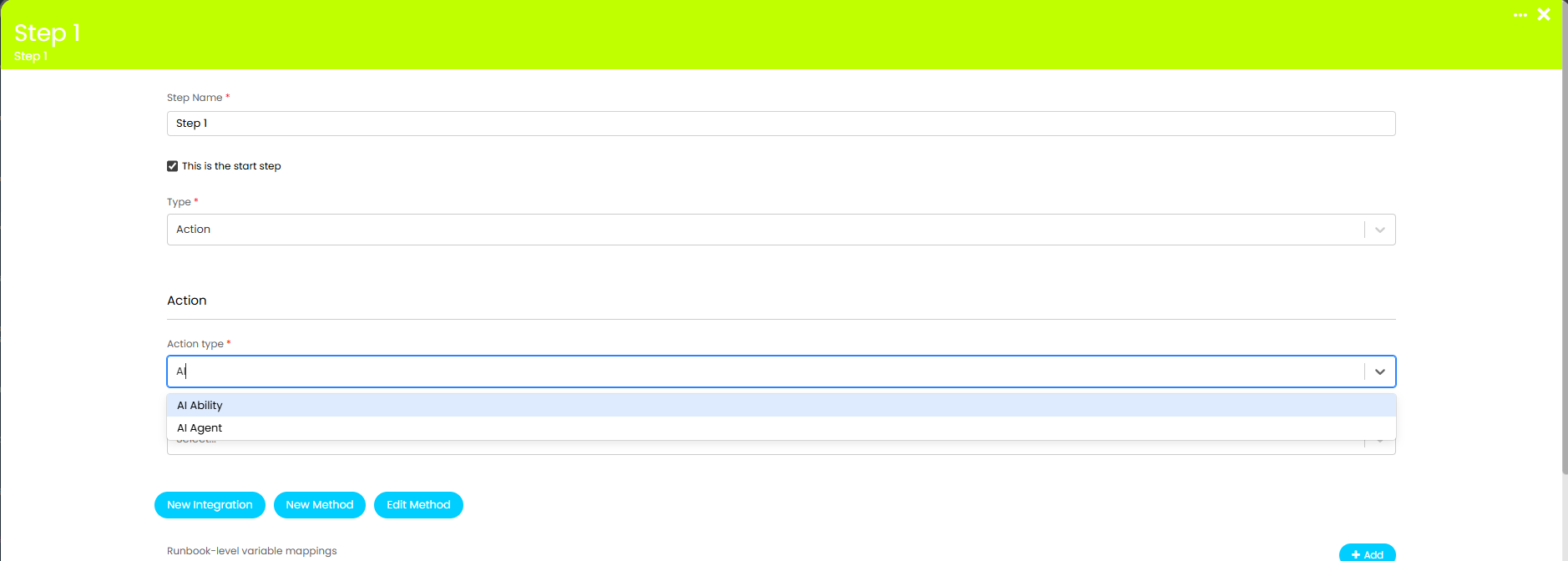
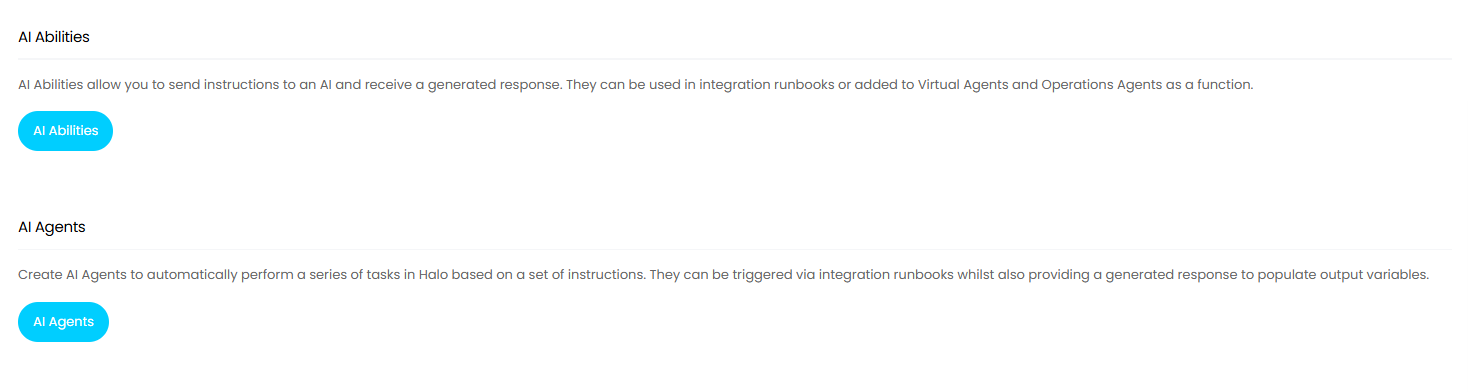
AI Agents are also introduced and can also be triggered via integration runbooks by selecting the ‘AI Agent’ action type on a runbook step. AI Agents are configured to automatically perform a series of tasks in HaloITSM based on a set of instructions and have access to the same Halo functions available via the MCP server, including ticket data retrieval, knowledge base search, and adding actions to tickets. When configuring an AI Agent, a Halo Application must be selected for it to authorise with, which determines the agent’s identity and permissions. As with AI Abilities, input variables can be passed from the runbook into the agent’s instructions, and the agent’s response can populate output variables.
When the system creates a ticket, action, or KB article via AI, a flag is now recorded in the database for reporting purposes. The relevant field names are faicreated, aacreated, and kbaicreated, and can be set via the API using the ai_created property. The ID of the Virtual Agent, AI Agent, or MCP Tool Collection used to create the entity is also tracked, correlating to the ID in the VirtualAgent table.
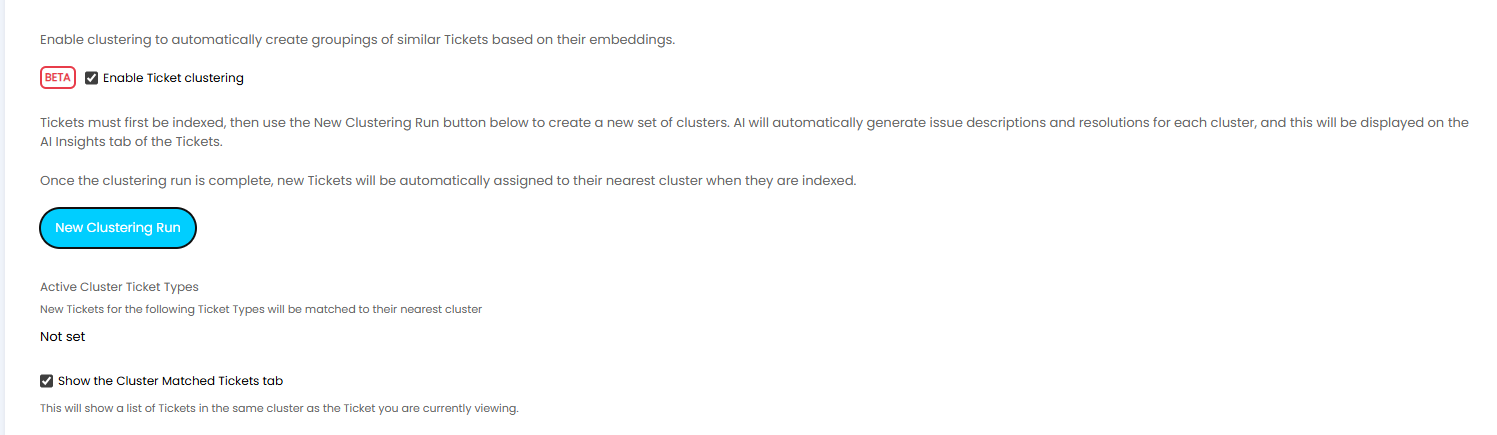
Last but not least, ticket clustering can now be enabled under Configuration > AI to automatically group similar tickets based on their embeddings. This helps identify the most common ticket types, track volumes per cluster, and surface new major incidents as they emerge. Each cluster is given an AI-generated description and resolution. A ‘Cluster Matched Tickets’ tab can also be enabled to show other tickets in the same cluster as the one currently being viewed. Previous clustering runs are archived in the database, allowing you to report on cluster volume changes over time via the API’s Cluster endpoint.
Furthermore, a number of interface and usability improvements have been made in this release.
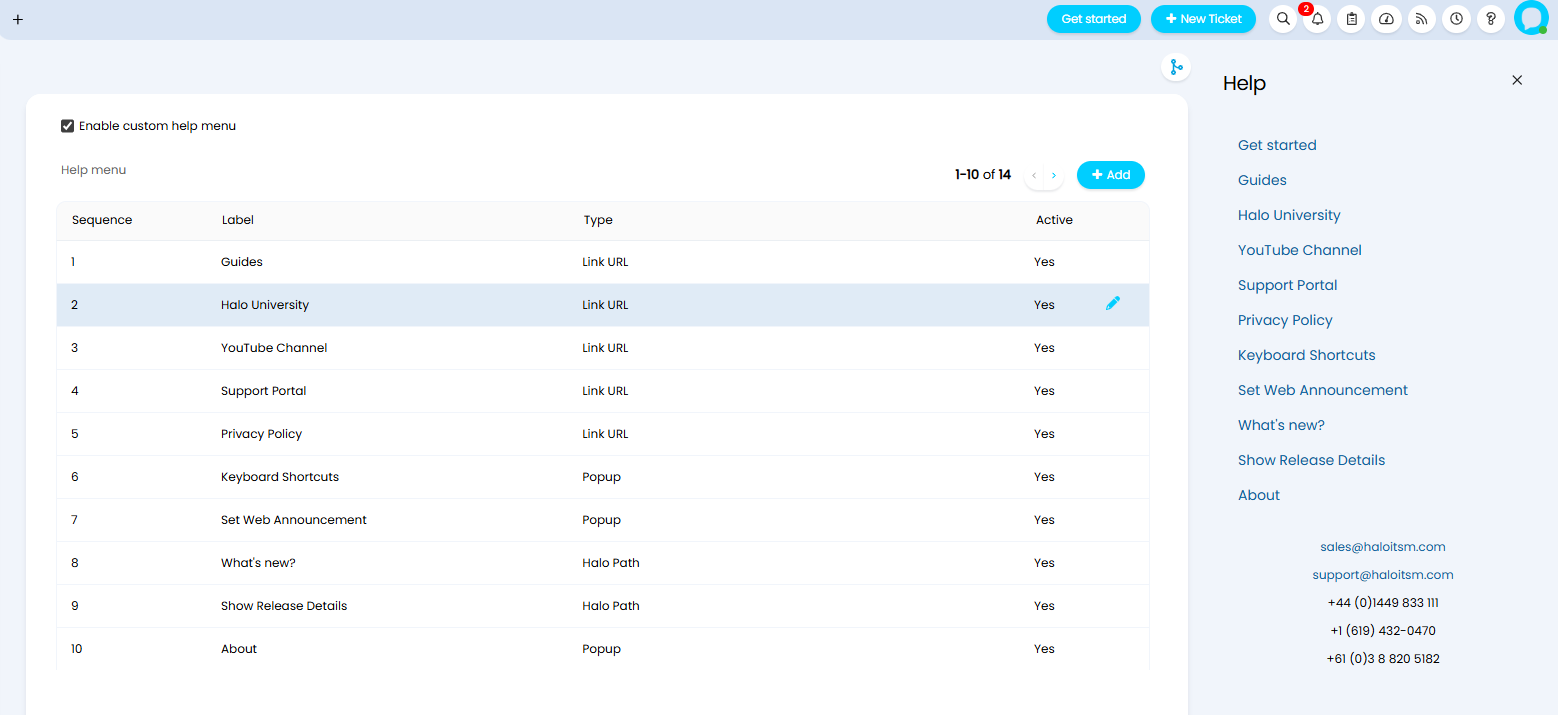
A custom help menu can now be enabled under Advanced Settings. Once active, a configuration table allows you to modify or deactivate the default system help menu options by editing their labels and links, as well as adding your own entries, for example, a direct link to your internal config tracking or knowledge base.
Moreover, Custom fields now support a new ‘Hover’ option for the Hint Display Type setting. When selected, the field hint is only shown when a user hovers over a question mark icon next to the field, keeping forms cleaner without hiding useful guidance entirely.

Thirdly, A new ‘Live Chat Notification’ notification type has been added alongside a new ‘New Live Chat Request (From User)’ event trigger, allowing agents to receive browser notifications when a new live chat request comes in from a user.

Finally, the Gantt chart has also been updated with improved visuals across the ticket, agent, and project views.

Approval steps can now be configured to run in parallel by grouping them together. Each step can be set as ungrouped, the main step of a group, or a member of a group.

When steps belong to the same group, they all start simultaneously when the approval process reaches the main group step. Steps within a group inherit certain configuration from the main step, including outcome notifications and status changes, meaning all steps in a group must be ordered sequentially with the main group step first.
The process rejects if any step in the group reaches its rejection threshold, and approves once all steps have met their approval thresholds.

Additionally, Risk Score is now available as a criteria when configuring approval process rules, allowing approvals to be routed based on a ticket’s calculated risk level.
When ‘Enable Ticket list dynamic filters’ is enabled in Tickets > General Settings, a new option ‘Use groups for dynamic filters’ is now also available.
Enabling this changes the dynamic filter behaviour so that filters can be organised into groups of up to three. Criteria within a group are applied as a logical AND, while each group is then applied as a logical OR against the others.
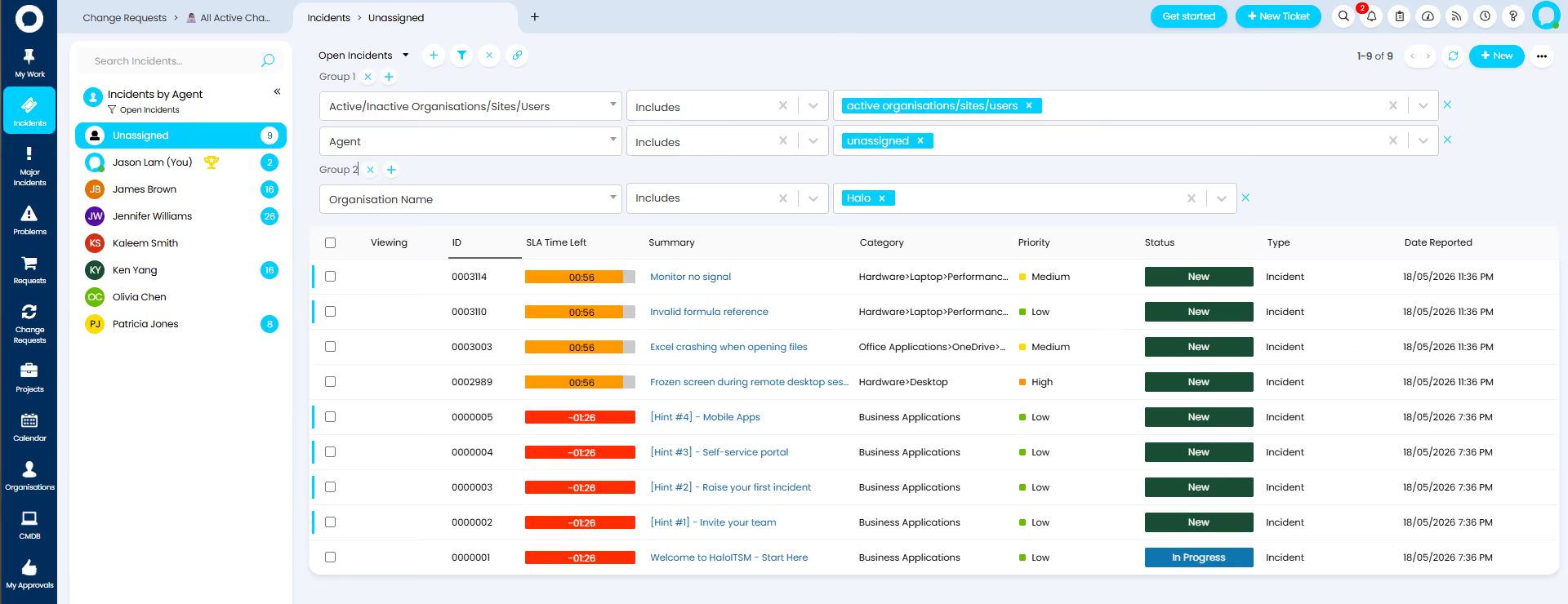
This makes it possible to build more nuanced filter combinations. For example, finding any ticket assigned to a specific agent, or any new unassigned ticket, in a single saved filter.
When adding a workflow step, there is now an option to ‘Create a stage automatically’. The stage will share the same name as the step and will update automatically if the step name changes, keeping workflow stages and steps in sync without manual maintenance.

‘Start an approval process’ is also now available as an option for workflow automations, making it possible to trigger approval processes directly from a workflow step without additional configuration.
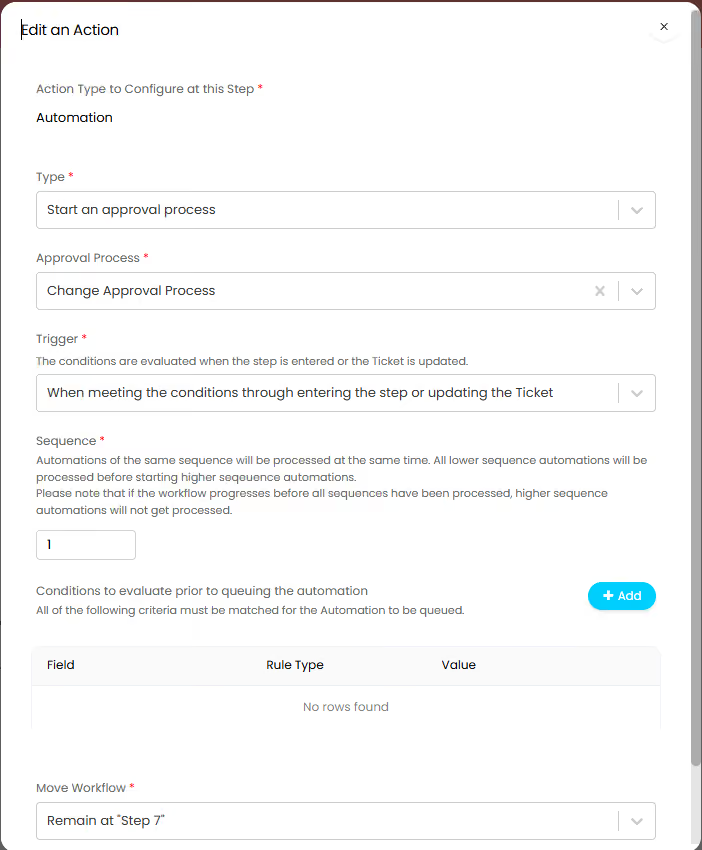
Additionally, automations on workflows can be given a sequence number between 0 and 10. All automations sharing the same sequence value are queued together, with processing starting from the lowest value. This makes it possible to control execution order where one automation depends on the result of another, or where two automations could otherwise attempt to update the same data simultaneously.
This release extends role-based access control to several additional areas of the platform, giving administrators finer control over who can view and manage key configuration.
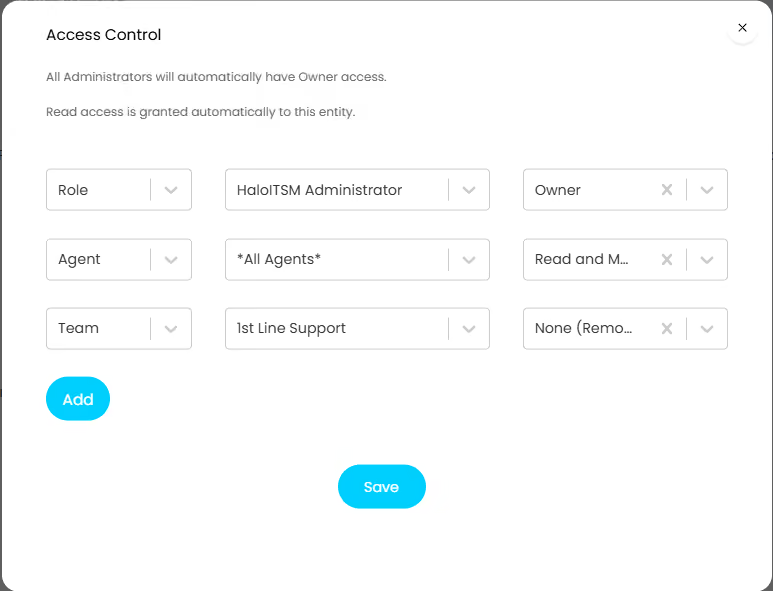
Event Management Rules can now be restricted by agent role, individual agent, or team, preventing unintended changes to the rules that drive automated event handling, particularly important for organisations running event-driven automations at scale.
Similarly, agent custom fields within the My Preferences area can now be restricted per agent role or individual agent, keeping fields that serve internal administrative purposes away from general agents.
Last but not least, in this release, access control has also been extended to the Active Directory configuration and to approval groups, giving administrators the ability to control who can view and manage these areas within HaloITSM.
Several improvements have been made to the Self-Service Portal experience this quarter.
When ‘Include Children’ is enabled on a column profile, child tickets are now grouped under their parent on the portal’s ‘My Tickets’ view, giving users a cleaner and more structured view of related work. The column profile to use for child tickets is configured on the Settings tab of the relevant ticket type.

It is also now possible to display additional user information when a user logs a new ticket on the portal. Two new settings at ticket type level, ‘Show additional User details when logging new Tickets’ and ‘User detail fields’ allow you to specify which user fields appear below the contact section on the new ticket form, including both default and custom user fields. The display order is controlled by the sequence property.

Additionally, the service catalogue now supports two new optional categories: the user’s top 10 most recently logged services, and the top 10 trending services. Both can be enabled through the services configuration settings where services can be excluded from favourites if they are also excluded from these categories.

A new setting ‘Show attachments in an attachments tab on Ticket details’ is now available in the Self-Service Portal settings, allowing attachments to be surfaced in a dedicated tab on the ticket detail view for portal users.
It is now possible to configure a default ticket type against a Configuration Item or Asset Type to log a ticket directly from an asset record on the Self-Service Portal, making it faster for users to raise issues or requests linked to a specific asset without having to navigate away and re-enter the asset details manually.

Performance when querying asset fields in the Query Builder has been improved, reducing load times when building reports against large asset datasets. Additionally, article permission enforcement has been added; When enabled, any Query Builder report on KB Articles will automatically restrict results to only those articles the running user has permission to see, ensuring report outputs respect existing knowledge base access controls.

A new Security Questions module is now available under Users configuration, allowing you to set up identity verification questions for users calling in to the service desk.
You can configure the questions users must answer, with optional validation against minimum length, maximum length, and regex patterns. The number of questions presented (up to five) and the pass/fail thresholds are all configurable by setting the number of questions to be answered correctly and the number of incorrect answers permitted.

Users who have not yet set their answers will be prompted to do so on the portal, and can update them at any time from their preferences page with additional guardrail to determine if answers can be displayed as plain text or masked as passwords.
On the call screen, once a user has been selected, the agent can initiate a security question check. The user provides their answers verbally and the agent validates them in real time. If validation passes, the user is saved against the call.

It is now possible to trigger notifications when OLAs reach specified thresholds, functioning similarly to the existing SLA notification system.
Under Configuration > Service Level Agreements > General Settings, up to three separate OLA notification thresholds can be defined. These can be set as a percentage of the OLA time elapsed or as a number of working hours remaining.
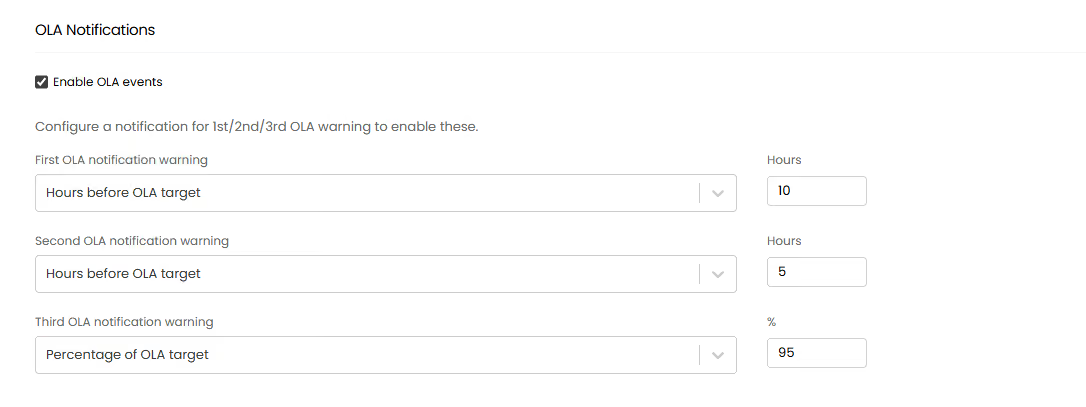
Once configured, notifications, webhooks, or runbook events can be triggered when each threshold is reached.

Notification trigger dates are automatically recalculated when an OLA is paused and unpaused, keeping them accurate throughout the ticket lifecycle.
Three improvements have been made to the integration runbook experience in this release.
A new button is now available on Integration Runbook steps, allowing you to view the request and response log for that specific step directly within the platform. This makes it significantly faster to diagnose issues with API-driven automations without relying on external tools.

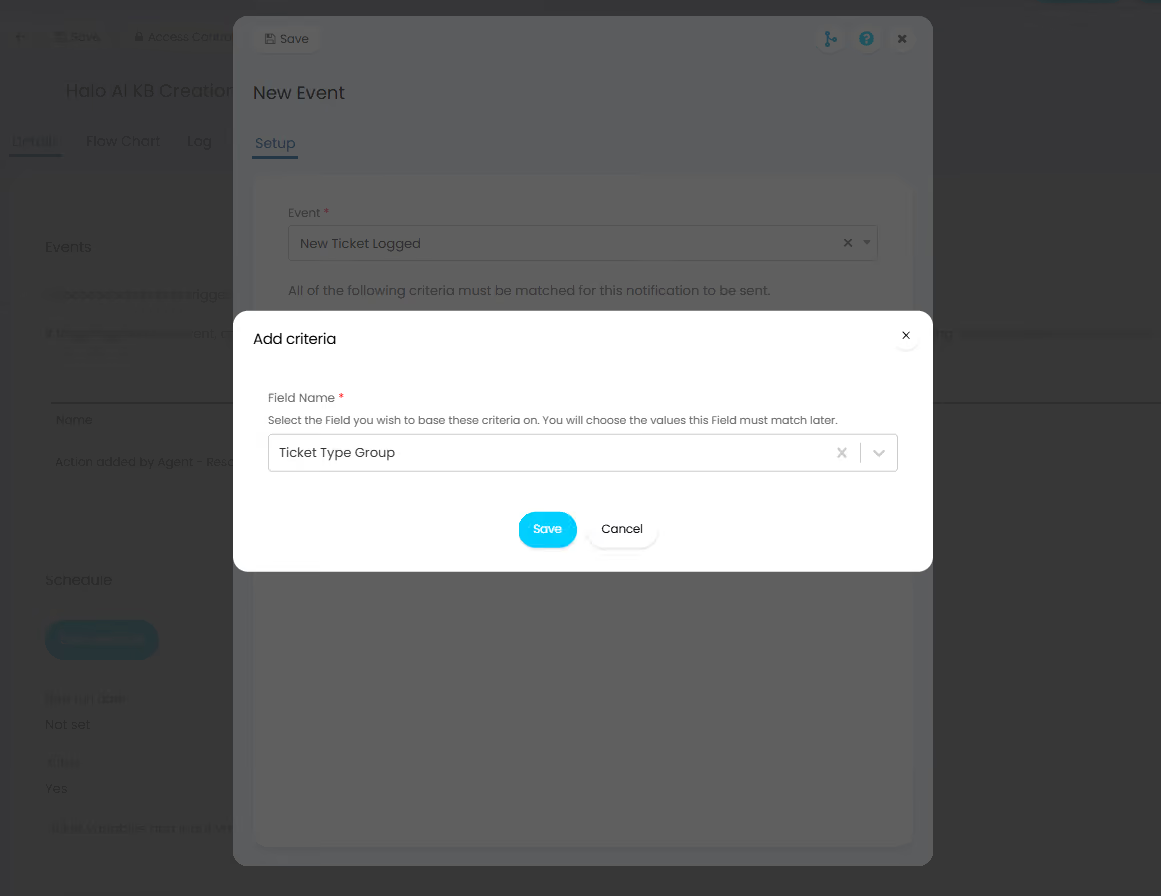
Ticket Type Group is now available as a condition for triggering notifications and runbooks, extending the flexibility of automation logic for organisations that use ticket type groupings to structure their services.
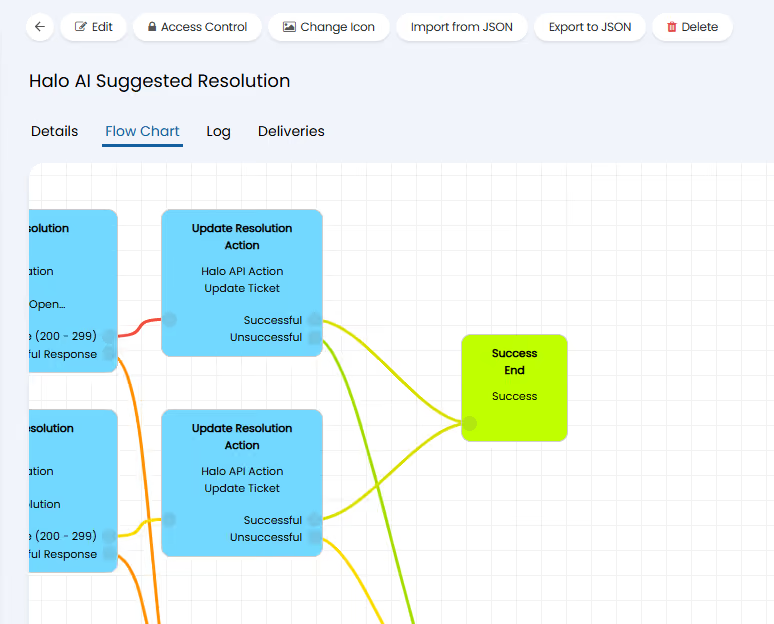
Finally, End (Success) steps in the runbook flowchart designer now appear in green, making it easier to distinguish successful completion paths from other step types at a glance.
A new Attachment field type is now available when configuring custom fields for tickets. This requires client-side uploads to be enabled.
When added to a ticket type, the field renders as a drop zone on the portal when creating a new ticket, supporting multiple file uploads. Once the ticket has been created the field becomes read-only, displaying clickable file links. Attachments added through this field also appear in the ticket’s Attachments tab and can be managed from there, including permanent deletion.

When configuring recipients for a scheduled report, a new ‘Recipient Type’ option is now available. Switching from ‘Manual’ to ‘Distribution List’ allows you to select an existing distribution list as the recipient, removing the need to maintain individual email addresses on each report as team membership changes.


For further information and to see all new features, click the question mark in the top right of your screen, then select ‘Show Release Details’.

To find out more information about future developments, look at our roadmap here!
If you’d like to speak to one of our team about specific features, or have any more specific questions, please contact your Customer Success Manager or feel free to contact us and we will get in touch as soon as we can.